
Starting a musical instrument is an exciting step. But for many children, teenagers and adults, one question comes first: which instrument should I choose?
Guitar and ukulele are both excellent instruments for beginners. They share many similarities, yet they offer quite different experiences. The ukulele provides an accessible introduction to playing music. The guitar, meanwhile, opens the door to an exceptionally broad musical world. So, guitar or ukulele? There is no universal answer. The best instrument is ultimately the one that makes you want to pick it up and play.
Ukulele: a Small Instrument with a Big Voice
The ukulele has several advantages for beginners, particularly for younger children. Its compact size makes it comfortable to hold, and its four strings simplify the first chord shapes. It is also possible to accompany simple songs relatively quickly. That early sense of achievement can be extremely motivating.
But the ukulele should not be seen merely as a simplified guitar. It is a genuine instrument with its own sound, repertoire and character. Beyond the first few chords, students can explore rhythm, melodies, fingerpicking and increasingly sophisticated musical ideas.
For children, it can provide an excellent introduction to fundamental musical concepts. It also requires less physical effort at the beginning. For adults, it offers something equally valuable: immediacy. You can start making music relatively quickly while still having plenty to discover as your playing develops.
Guitar: a Wider Musical Playground
The guitar requires a little more coordination at first. Six strings mean more possibilities, but also more information for the hands and brain to process. Some chord shapes require patience. Developing comfortable finger placement also takes time.
The reward is an extraordinarily versatile instrument. Classical music, pop, rock, folk, blues, accompaniment, riffs, melodies, fingerstyle and improvisation can all become part of the journey. A beginner may start with just a few notes or simple chords. Gradually, the connections between these elements begin to appear across the fretboard.
This is where learning guitar becomes particularly interesting. The instrument is not simply a collection of chord shapes to memorize. The fretboard is a musical system that can gradually be understood. Notes, intervals, chords and scales are connected. Discovering these relationships can turn technical learning into genuine musical understanding.
Learning Songs — and Understanding What You Play
Playing recognizable music is one of the best sources of motivation when learning an instrument. A first riff, a familiar melody or the ability to accompany a song can make practice meaningful. This is particularly important for beginners. Making music should not be postponed until after months of technical preparation.
At the same time, learning songs and understanding music do not have to be separate activities. A chord can become an opportunity to discover which notes it contains. A melody can introduce intervals, while a song can develop rhythm and listening skills. Moving the same musical idea elsewhere can also reveal how the instrument is organized.
This approach is central to lessons at NiQo Music School: technique serves music, and theory serves understanding. The objective is not simply to reproduce what the teacher demonstrates. Students should progressively understand what they are playing and become more autonomous as musicians.
Guitar or Ukulele for a Child?
Age matters when choosing a first instrument, but it should not be the only criterion. For a young child, the ukulele often has an immediate physical advantage. It is small, light and relatively easy to handle. The first chords are also accessible without requiring too much finger strength. This allows children to experience the pleasure of accompanying music quite early.
A suitably sized guitar can nevertheless be an excellent first instrument. This is especially true when a child is already strongly attracted to its sound or repertoire. Motivation matters enormously. A child fascinated by guitar should not automatically be directed towards ukulele simply because it appears easier. Conversely, a child who enjoys singing and strumming may find everything needed to begin with a ukulele.
The question is therefore not only “Which instrument is easier?” It is also “Which instrument makes this student curious?” Curiosity is one of the strongest engines of musical progress.
What About Adult Beginners?
Adults sometimes approach their first music lesson with an unnecessary concern: Am I starting too late? Music does not have an expiry date. Learning an instrument as an adult can be an extremely rewarding experience.
Adult beginners also bring useful strengths to the learning process. These include patience, analytical thinking and clear musical tastes. Adults can also understand concepts that younger students may initially approach more intuitively. The challenge is often not ability. Instead, it is finding a learning path that fits realistically into professional and family life.
The ukulele can be ideal for someone looking for a relaxed and accessible introduction to music. The guitar may appeal more to someone with particular songs, artists or musical styles in mind. In both cases, lessons can be adapted to individual objectives. There is no need to force every student through exactly the same path.
Can You Start with Ukulele and Move to Guitar Later?
Absolutely. Many musical skills transfer naturally between the two instruments. Rhythm, coordination, listening and finger independence are not limited to one instrument. The same is true of many concepts related to melody and harmony.
The physical patterns will change, of course. A guitar has six strings, a different tuning and a longer scale length. But an experienced ukulele player already has valuable musical foundations. Listening, keeping time and coordinating both hands do not disappear when changing instruments. Neither does an understanding of notes and chords.
The ukulele can therefore be a destination in itself or the beginning of a longer musical journey. There is no obligation to “graduate” from ukulele to guitar. They are different instruments, and each can be explored as far as the musician wishes.
So, Guitar or Ukulele?
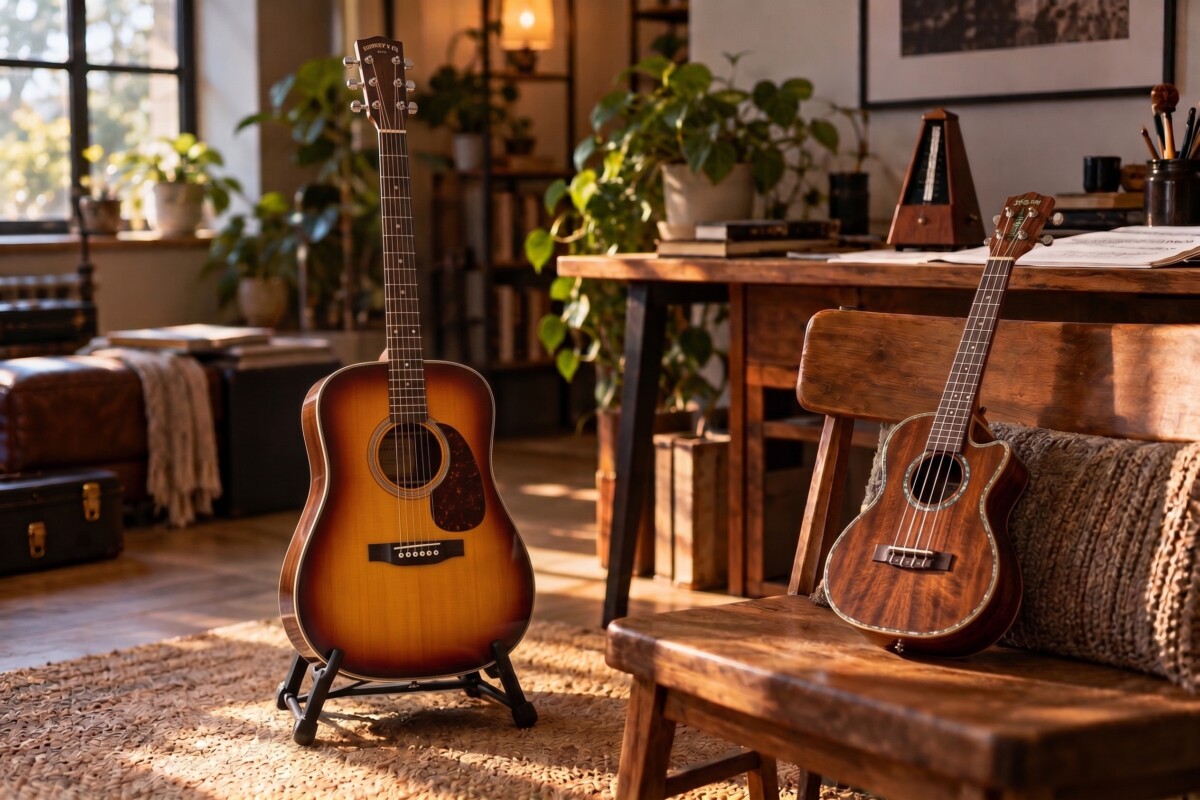
For a very young student, the ukulele can be an excellent choice. It is compact and allows many beginners to reach their first songs quickly. For someone specifically attracted to guitar music, starting directly with guitar makes perfect sense. It offers an enormous repertoire and many possibilities for accompaniment, riffs and improvisation.
And when the answer is not obvious, there is no need to make the decision theoretically. Sometimes the best solution is simply to hold both instruments and play a few notes. One of them may immediately create a stronger connection.
After all, choosing a first instrument is not about finding the easiest possible path. It is about finding one that gives you a reason to continue.
Starting a musical instrument is an exciting step. But for many children, teenagers and adults, one question comes first: which instrument should I choose?
Guitar and ukulele are both excellent instruments for beginners. They share many similarities, yet they offer quite different experiences. The ukulele can provide a wonderfully accessible introduction to playing music, while the guitar opens the door to an exceptionally broad musical world. So, guitar or ukulele? There is no universal answer: the best instrument is ultimately the one that makes you want to pick it up and play.
Guitar and Ukulele Lessons at NiQo Music School
NiQo Music School now offers guitar and ukulele lessons in Dübendorf, near Zurich, for beginners and intermediate students. Lessons are personalized according to age, experience, musical interests and individual objectives, with formats designed to accommodate different learning rhythms and schedules.
Depending on the student, lessons can combine songs, chords, melodies, rhythm, technique and music theory, while progressively introducing improvisation and a deeper understanding of the instrument. The aim is to build solid foundations without separating technique from the pleasure of actually making music.
Whether the journey begins with four strings or six, what matters most is developing curiosity, understanding and the confidence to gradually find your own way through music.